For product context, see the air purifier housing mold page.
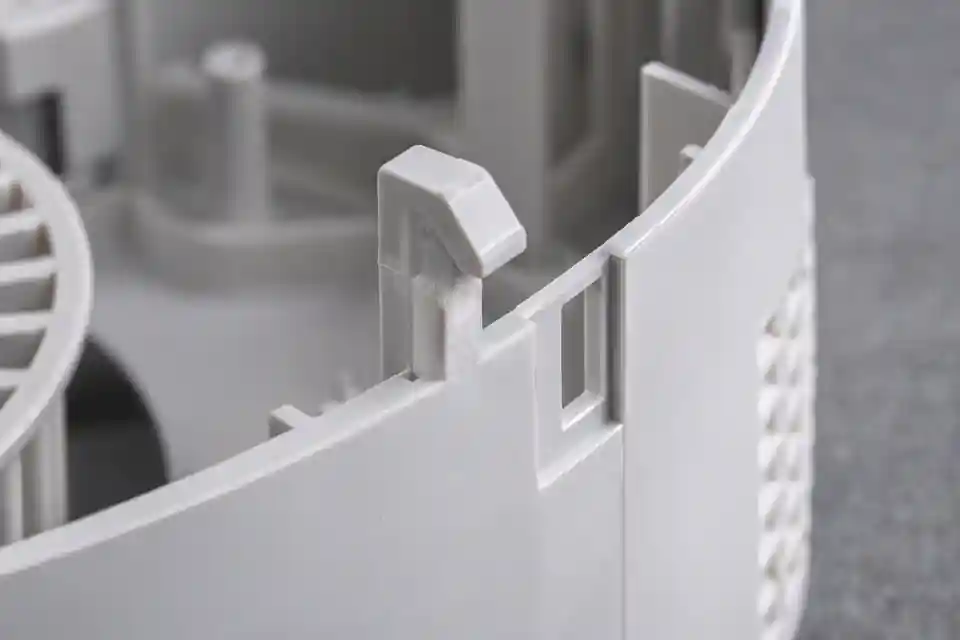
White marks around an air purifier housing clip are evidence of local deformation, not a complete root-cause diagnosis. First separate whitening at the cantilever root from a crack, a damaged catch, a mismatched shell seam, or an ejection mark. Record the exact shell revision, resin grade, color, assembly direction and whether the mark appeared after molding, first assembly, disassembly or repeated service. This review treats the snap as one part of a housing system; it does not claim that every white mark means failure.
1. Locate the symptom before changing the mold
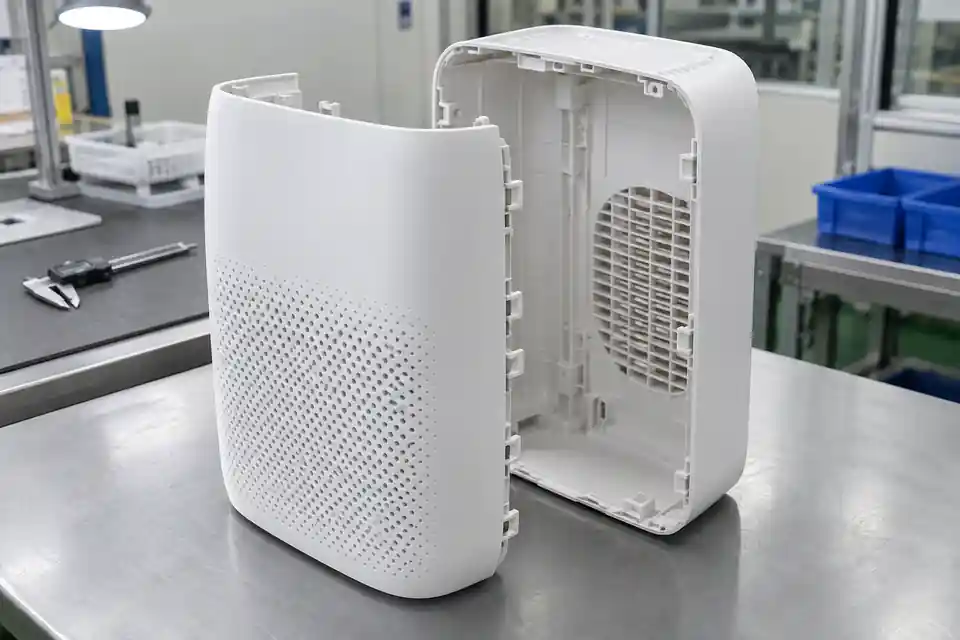
Mark each affected clip on the open and assembled CAD models. Photograph the root, beam, hook and mating window under the same lighting, and compare affected and unaffected positions. A mark at the root suggests a different review path from rubbing at the hook or a seam that will not close. Do not enlarge the catch or increase interference until the location and assembly motion are confirmed.
Protolabs explains that clips and snap-fits introduce flex and stress, so resin choice matters; a more flexible resin may tolerate the feature differently from a stiff or brittle one. This is a design relationship, not proof that one resin will solve this housing. See the Protolabs injection molding guide.
2. Lock the actual material and condition
"ABS housing" is not a complete material specification. The project record should identify the exact grade, color package, additives, recycled-content condition if applicable, drying or conditioning requirements supplied by the material maker, and any approved substitutions. A material change can alter stiffness, strain response, shrinkage and appearance, so samples from different lots or recipes should not be mixed in one conclusion.
The article does not prescribe a universal resin, moisture value or process setting. Material data and supplier guidance must be evaluated against the real clip geometry, use temperature, assembly frequency and service requirement.
3. Review beam geometry, root transition and required deflection
BASF's Snap-Fit design description identifies beam width, thickness, length, lead angle, return angle and the deflection needed to clear the catch as relevant inputs. Its result is an initial engineering estimate, not an automatic product approval. Review the full flexing length, the root transition, the hook, the mating window and the shell support together; changing only one dimension can move stress elsewhere. See the BASF Snap-Fit design explanation.
Sharp transitions can concentrate stress. Protolabs notes that radii can improve flow and part integrity, while draft supports release from the mold. Any radius, draft or interference change must remain conditional on the actual material, tooling direction, visible surface and assembly force; this article intentionally gives no universal numeric rule. See Protolabs injection molding basics.
4. Check molding, flow and ejection before blaming assembly
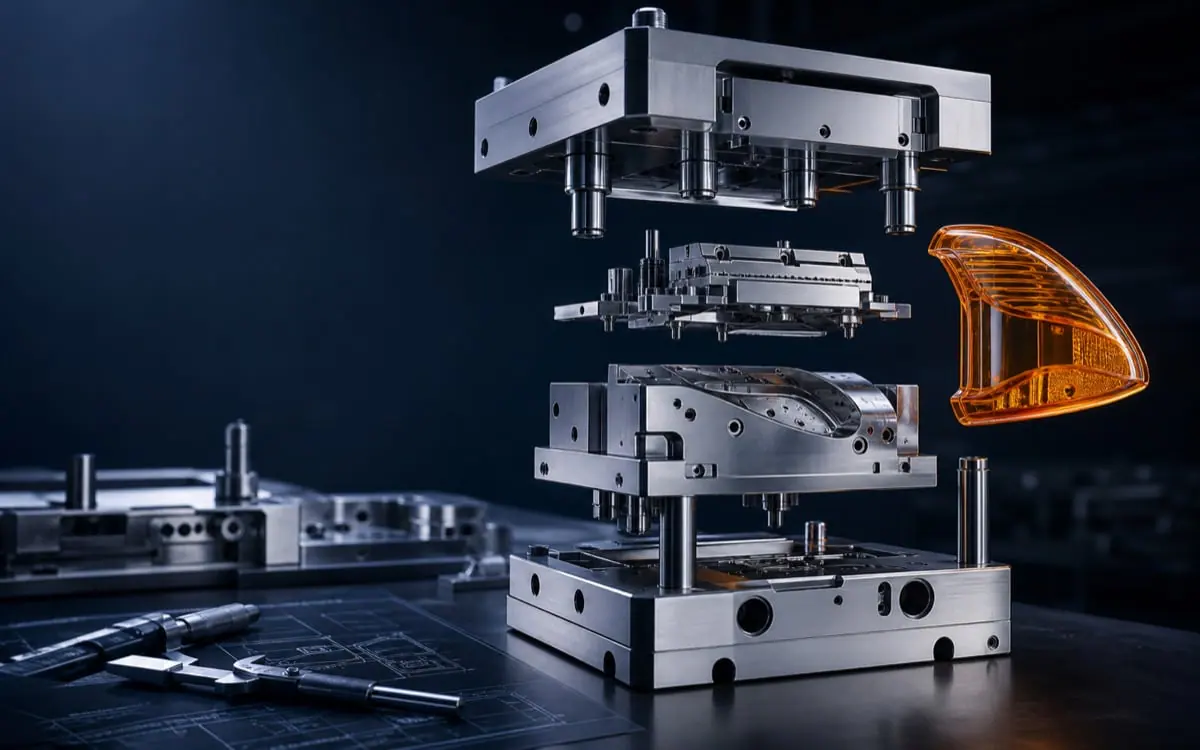
The clip may be affected by filling pattern, local weld behavior, packing, shrinkage, cooling imbalance or ejection. Review gate and flow assumptions, clip orientation, venting, draft, steel access and ejector contact together. Protolabs notes that snap features may require a sliding shutoff, relief opening or side action depending on geometry and mold opening direction. See its complex injection-molding features guide.
These points are a review checklist, not a machine recipe. Keep process records linked to the sample and cavity; do not infer a mold correction from an isolated photograph.
5. Separate T1 observation from service-life proof
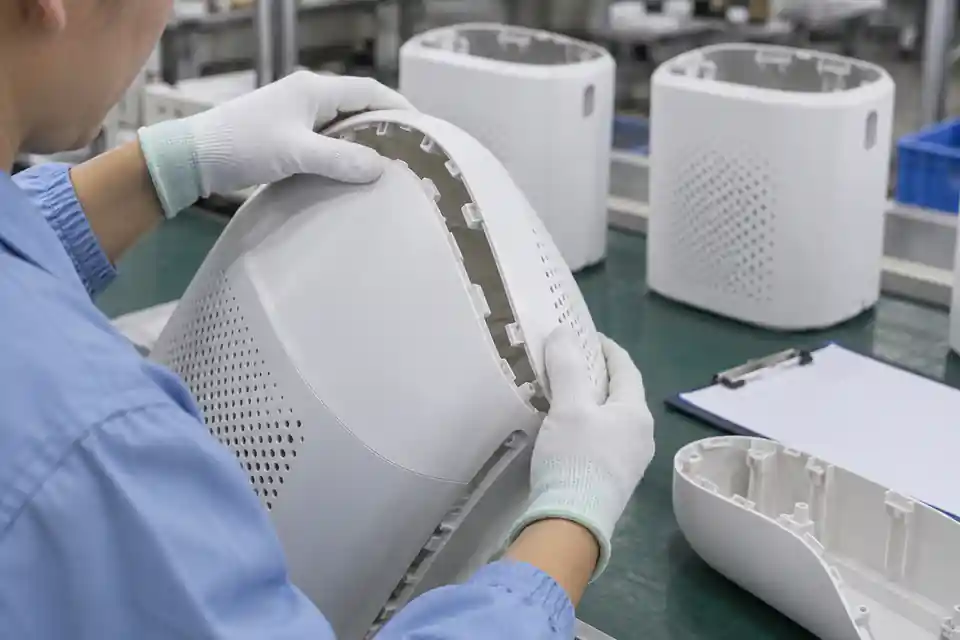
During T1, record the cavity, material lot, sample conditioning, assembly fixture or hand method, insertion direction, seam condition, removal method and photographs before and after assembly. Measure only against project-defined drawings and acceptance criteria. A sample that closes once has not demonstrated repeated-service life, and a white mark alone does not establish crack growth.
6. Inputs to close before tooling or correction approval
| Review item | Required input | Owner | Evidence |
|---|---|---|---|
| Symptom identity | Marked photos and open/closed CAD | Product / quality | Location agreed |
| Material state | Exact grade, color and approved substitutions | Purchasing / material | Traceable record |
| Snap geometry | Beam, root, hook, mating window and assembly path | Product / mold | Controlled drawing |
| Mold influence | Gate/flow, draft, release and ejection review | Mold / process | T1 and process record |
| Verification | Assembly method, seam check and project criteria | Quality / project | Versioned result |
This table is an editorial project-control suggestion, not an industry standard. The appliance mold category, mold review service and injection molding service provide related context. For broader drawing inputs, use the DFM purchasing review checklist. To review a specific housing, submit the CAD, resin specification and marked sample photos. No fixed life, process result or delivery outcome is promised.
Frequently asked questions
Does stress whitening mean the snap is already cracked?
Not necessarily. Whitening indicates localized deformation or optical change, while a crack requires separate inspection. Record both under consistent conditions.
Is ABS always suitable for an air purifier housing snap-fit?
No universal conclusion is possible. Grade, additives, geometry, environment and assembly requirement must be reviewed together.
Should we simply reduce the interference?
Not before confirming the assembly path, retention requirement, beam deflection and mating-shell variation. Reducing one value may create another fit problem.
Can one successful T1 assembly prove clip life?
No. Initial fit and repeated-service verification are different evidence sets; project owners must define the latter.
What should be supplied for a tooling review?
Provide open and assembled CAD, exact resin and color information, marked defect photos, assembly sequence, affected cavity/sample records and project acceptance criteria.