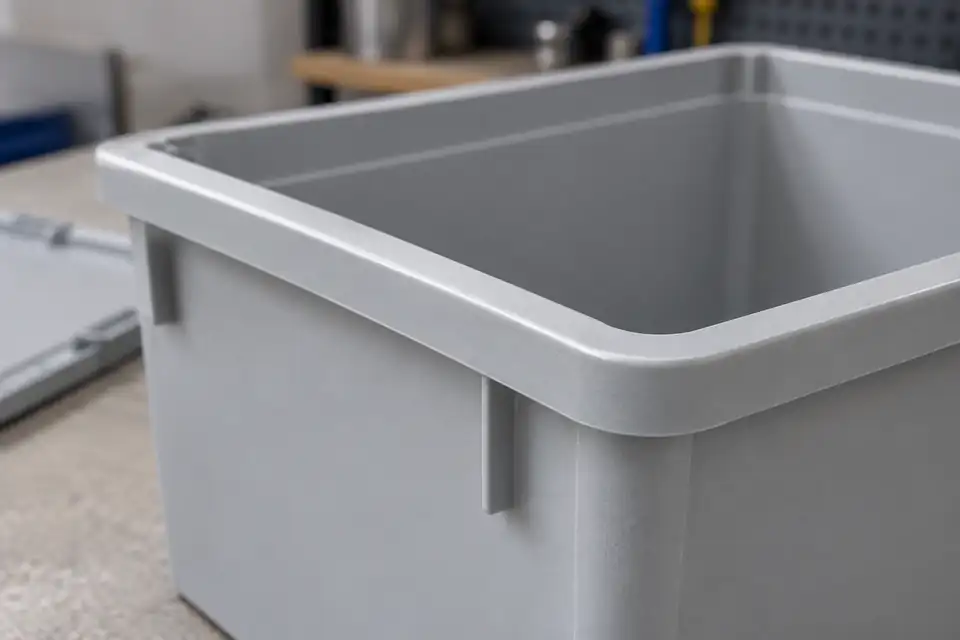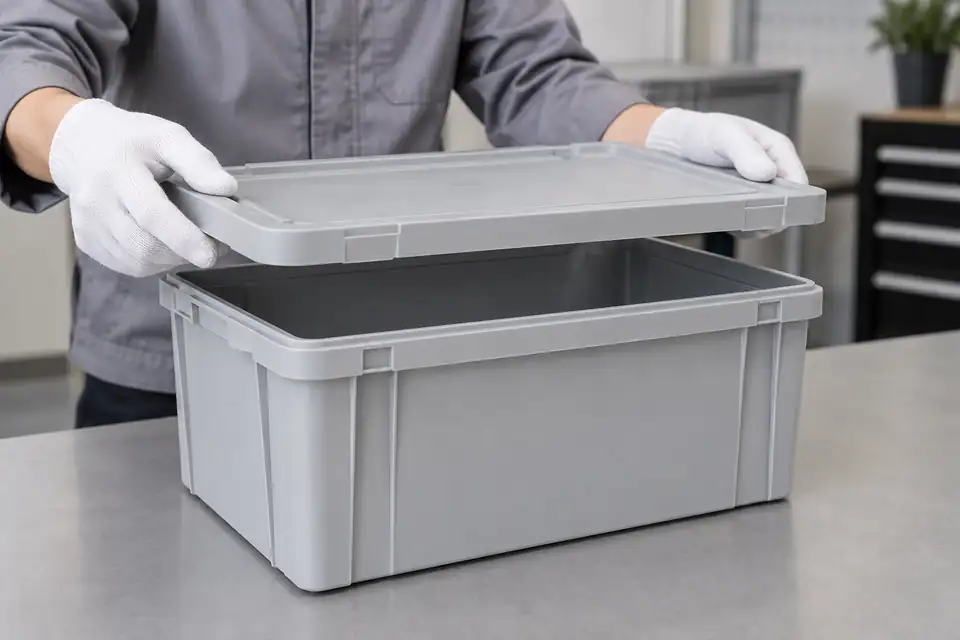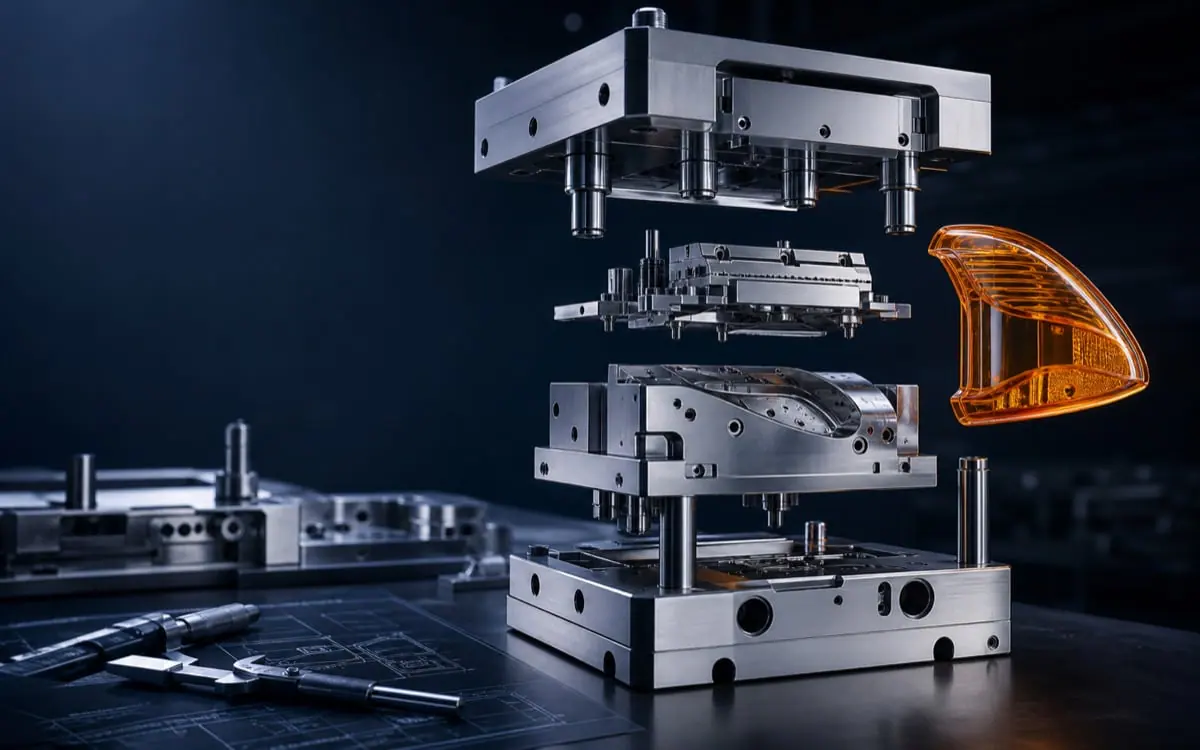
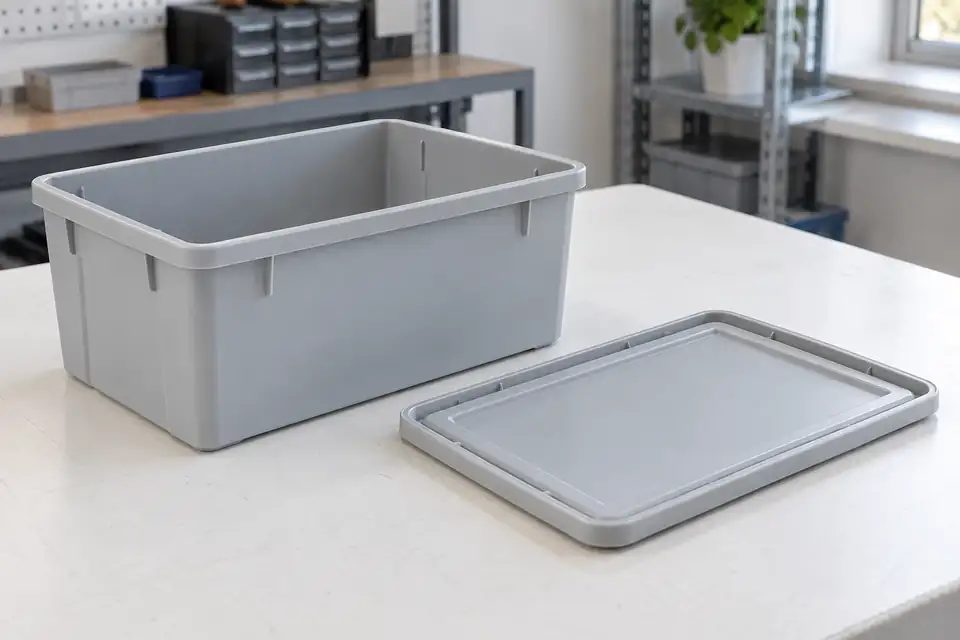
A lid that is hard to close or a gap that varies around the rim should not be assigned to the box body alone. Put the body and separate lid in the same model revision, identify their real contact, locating, or latching regions, and record shape change, fit dimensions, and observation state separately. This article covers a generic thermoplastic injection-molded storage box; it does not assume PP, PE, ABS, or a particular grade. Displacement relative to a best-fit plane is not the drawing flatness or the assembly gap.
1. Define where the lid fits before calling every gap warpage
On the current 3D/2D drawings, mark the body rim and the lid’s corresponding contact, locating, or latching regions. Do not add a latch or seal that the design does not contain. Record which area is hard to close or shows a gap, whether the observation is before or after assembly, and what shape or gap the project actually permits. A visible gap is not automatically a defect, and a lid that does not close does not prove body warpage.
Compare the body and lid in the same revision so that lid shape, fit dimensions, and design intent are not lost. Use the pre-mold DFM review checklist for general inputs and the storage box mold page for product context. The output of this section is an observation and a mapped fit region, not a root-cause verdict.
2. Follow the rim through the wall, corners, and lid edge
For wall-thickness variation, cooling, and warpage risk, see the Protolabs injection molding guide; for assembly dimensions and draft effects, compare the Protolabs molding-tolerances article.
Review adjacent sections through the wall-to-rim transition, rim corners, and lid edge. If ribs, latches, or other local features exist, check their relationship to the controlled fit area. Uneven wall regions, cooling differences, and shrinkage are factors worth considering in a warpage review, but they do not predict which side must deform.
Thickening the rim, changing wall draft, or revising the lid edge can all move the original fit relationship. Define the drawing location and datum before comparing dimensions; measurements from different heights or references should not be treated as directly comparable. Draft also changes geometry, so manufacturing constraints can be discussed with mold design and manufacturing services.
| Review region | Body/lid revision | Observation or design intent | Section to confirm | Item pending validation |
|---|---|---|---|---|
| Rim and lid edge | To be supplied | Contact, locating, or gap | Corner and lid-edge section | Shape and fit |
| Wall and local feature | To be supplied | Support or latch, if present | Wall-to-rim transition | Deformation and manufacturability |
3. Treat material and molding conditions as inputs, not a reason to pick one machine action
For conditional process evaluation and reanalysis after a change, see Autodesk’s differential-shrinkage warpage guidance; material selection still returns to the project’s functional requirements.
Confirm the specified resin grade, fillers or modifications, color, and current geometry and process revision. If the information is missing, mark it as to be supplied. Do not infer material from appearance or assume a storage box uses PP. Material, geometry, and molding conditions belong to the same analysis input set.
If the engineer proposes changing packing, wall geometry, cooling-related conditions, or material, record what changes, what cannot change, and how the effect will be verified. A conditional design or process direction must be reanalyzed after the input changes; increasing packing, extending cooling, or changing material is not a guaranteed correction for rim warpage. For sample and process validation context, see molding and injection services. This article gives no temperature, pressure, time, or resin recipe.
4. When reading warpage analysis, ask for the reference and the fit region first
For displacement results, reference planes, and assembly interpretation, see Autodesk’s deflection-result guidance.
Discuss colors, displacement, or deformation direction only when the project has an actual analysis result; otherwise mark the item as pending analysis. Before reading a warpage result, confirm the result type, reference method, display magnification, model revision, and input conditions. Some software results report displacement relative to a best-fit plane, and the display may be magnified.
A maximum displacement, directional displacement, or red area therefore cannot be renamed as drawing flatness, lid clearance, or an inspection failure. Mark the rim region and the corresponding lid surface on the result and ask which fit question the reading answers. Results from different inputs must not simply be subtracted to create an assembly gap. Simulation can compare options and frame questions; it does not replace sample fit validation or prove that LIZHI has used the software.
5. Turn the conclusion into paired body-and-lid validation
For each critical region, record the fit area, body/lid drawing revision, design intent, observation or prediction basis, inspection condition, and pending validation item. If the drawing specifies flatness, use its stated surface and inspection method; where it does not, do not invent a universal tolerance. Closing, latching, and locating functions must be checked against the actual design and project requirements.
Closing a lid once does not prove sealing, water resistance, durability, stacking-load performance, or production capability. Do not replace the unassembled observation with a hand-pressed condition or relax the real functional requirement. Continue with the pre-mold DFM review checklist, and submit the current body/lid drawings and fit question through submit body and lid drawings; daily-use product molds is related reading. This article does not promise zero warpage, a fixed lead time, or production acceptance.
Frequently asked questions
Does a lid that will not close prove the box rim is warped?
No. Check body and lid shape, corresponding dimensions, fit regions, and observation state first. The symptom is not root-cause evidence.
Will a thicker rim or more ribs solve the problem?
Not guaranteed. Compare the local section, molding effects, and fit function; one geometry change is not a universal answer for storage boxes.
If the software shows small maximum deformation, can the lid be approved?
No. Confirm the reference method, inputs, and actual fit location. Predicted displacement is not a lid gap or drawing flatness value.
What flatness or lid gap should every storage box use?
This article gives no universal number. Define it from the structure, use, fit method, and the project drawings and validation requirements; do not copy another supplier’s capability.
If the lid closes after being pressed by hand, has it passed?
Not automatically. Separate the original shape from the assembled state and validate closure, dimensions, and function under the agreed conditions. Hand-flattening is not proof that warpage is gone.