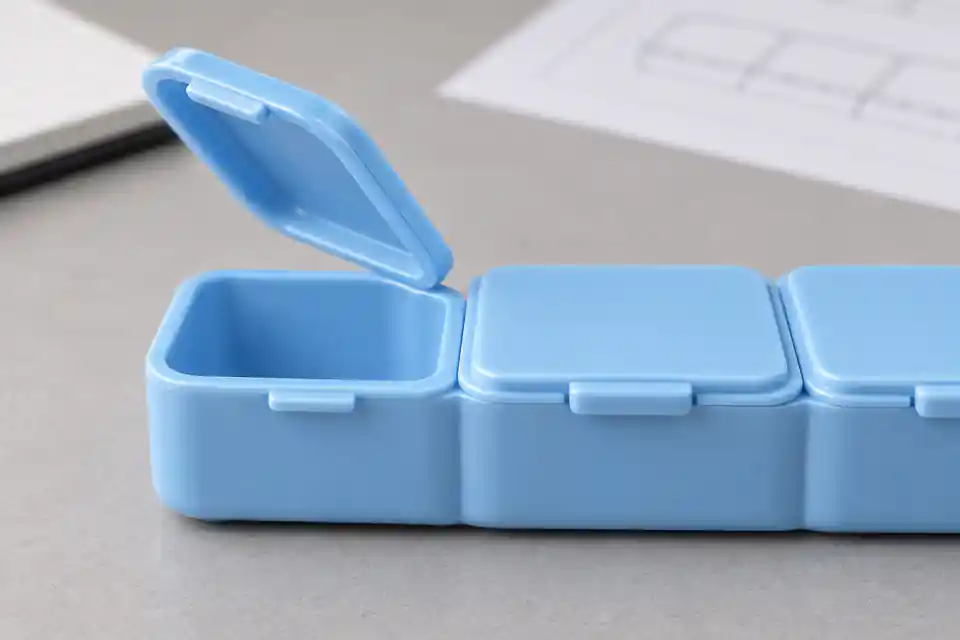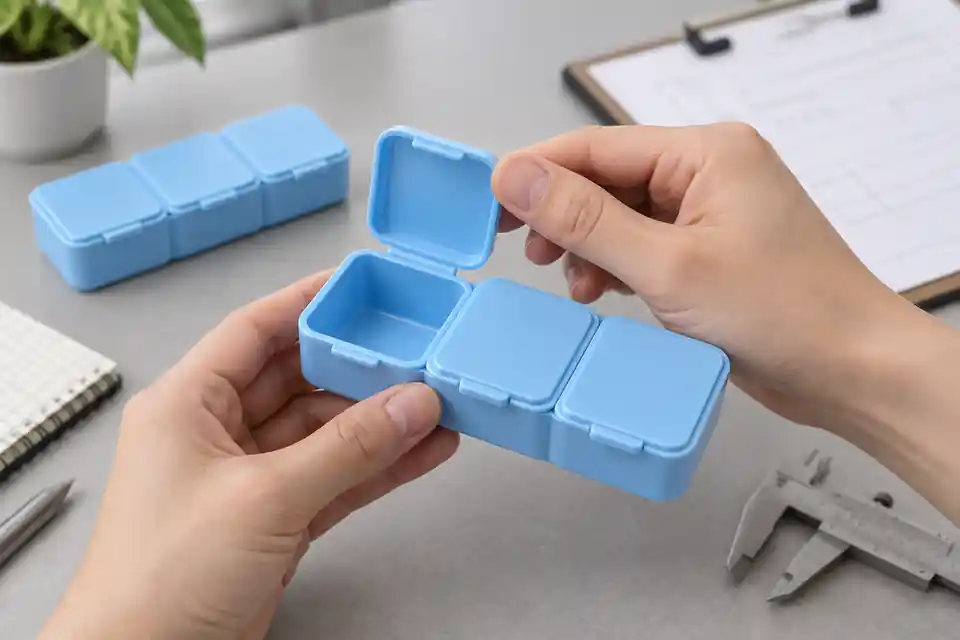
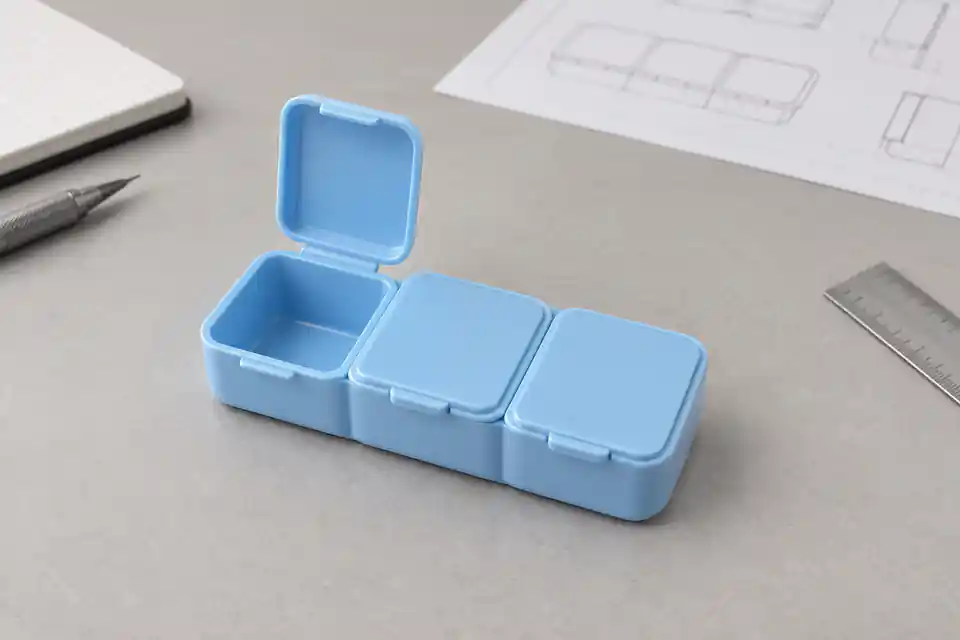
For the product scope, also see the pill-box mold product page.
When a living hinge cracks on an integral polypropylene (PP) pill box, a crack photo alone is not enough to decide “change the resin” or “make the hinge thicker.” First identify whether the failure is in the thin connection between the box and lid, the closing latch, or the lid-to-rim fit. A living hinge is a thin injection-molded region that allows folding so the box and lid can be made as one plastic part; the latch has a different closing function. For product scope, see the medical moulds directory. For the hinge definition and sample review, see Protolabs' living-hinge design guidance.
1. Locate the failure: living hinge or closing latch?
Mark the thin hinge, box, lid, latch tongue, and rim-fit surfaces on both open and closed views of the drawing. A photograph can locate a crack, but it cannot prove the root cause. Record the crack location, the motion during which it appeared, the sample revision, and whether the latch or fit also changed. Protolabs uses vitamin or mint boxes to distinguish a latch on one side from the living hinge that connects the lid on the other. This distinction is for engineering review only; it is not evidence of medical, food-contact, sealing, or child-resistance compliance.
If the crack is at the latch root, review closing interference and local stress separately. If it is in the continuous thin hinge, continue with resin, flex radius, and molding-condition review. Without open/closed models and failure-area photos, keep the cause as “to be confirmed” rather than placing a single diagnosis on a quotation or tool-change request.
2. Review the material: turn “PP” into a controlled resin version
PP is the material scope for this article, not proof that every PP grade will work for the pill box. Protolabs lists PP and PE as common living-hinge candidate materials and notes that example dimensions must be adjusted for the application and design. Ask for the exact resin grade, color system, filler or recycled-content condition, expected environment, and opening/closing duty. See Protolabs' living-hinge basics for the material and design background.
RTP's Living Hinge Design guidance also discusses PP and PE and proposes an initial bend soon after molding because of orientation in the thin region. That is RTP guidance for its stated design context, not a universal machine procedure for every grade or project. Record resin, color, filler, recycled content, supplier, or process changes as new validation inputs. Do not add a temperature, time, cycle count, or service-life claim.
3. Review the geometry: thin region, transitions, and the real closing radius
Do not replace geometry review with “thinner is more durable.” Material, hinge thickness, and bend radius act together; too small a radius or forced closing can damage the hinge. The relationship is discussed in Protolabs' fold-flat living-hinge article. The project drawing should show the thicker regions on both sides, transition shape, open and closed positions, and the available flex space—not only one local thickness callout.
The latch constrains closure, but it should not turn this article into a general latch-design tutorial. Check whether the lid follows its natural closing path, whether the operator or assembly must force it shut, and whether the hinge is over-folded at the end of closure. Supplier examples can start a discussion; they are not acceptance values. Re-review the geometry when the resin, color/filler condition, lid shape, or opening/closing duty changes.
4. Review filling: confirm how plastic passes through the hinge region
The narrow hinge region can restrict filling, and a meeting of melt fronts at the hinge may weaken that area. Protolabs' guide to complex injection-molded features also identifies filling and flash as manufacturability concerns when a one-piece box moves from a thick section through a thin hinge and back to a thick section. This is a local review point for the pill-box hinge. It does not prescribe one gate layout for every box or guarantee a weld-line-free result.
Ask the project team to keep the drawing revision, gating and venting assumptions, and any molding analysis with the same configuration. The mold and process engineers should confirm how material reaches the thin region, where melt fronts meet, and whether the cosmetic lid area is affected. Without analysis or trial evidence, keep these as risks to verify rather than treating one gate position as universally correct.
5. First-article review: separate the initial bend from later opening/closing checks
RTP proposes an initial bend soon after molding. The project team should confirm that the guidance fits the current resin grade, molded condition, and handling sequence before adopting it. An initial bend is a post-molding operation; it is not an in-use opening-life test. Protolabs' design guidance recommends further testing of living-hinge designs on samples before moving to larger production, but it does not provide a universal sample count, opening-cycle target, speed, or acceptance threshold for this pill box.
The first-article record should include resin and revision, post-mold storage and initial handling, bend direction and range, observation conditions, crack location, lid fit, and abnormal photos. Keep the initial-operation record separate from later opening/closing validation so one manual bend is not presented as a durability result. The project owner defines the acceptance criteria for the intended use.
6. Close the input loop before tooling or a tool change
Purchasing does not need to guess a universal thickness. It should collect the following inputs for product, tooling, and quality owners to confirm together:
| Item to confirm | Required input | Owner | Acceptance basis |
|---|---|---|---|
| Structural identity | Open/closed models, hinge region, latch location | Product engineering | Failure-area definition |
| Resin version | PP grade, color, filler/recycled content, change record | Purchasing/materials | Traceable material version |
| Flex duty | Opening direction, closing path, use environment | Product engineering | Project-use requirement |
| Molding risk | Filling, melt-front meeting, flash, and vent review | Tooling/process engineering | Drawing or analysis revision |
| First article | Initial bend, observation record, later flex plan | Quality/project engineering | Project acceptance conditions |
This table is an editorial planning aid, not an industry-mandated form. Use the mould service and injection service as project discussion points; the DFM purchasing review checklist can help organize general drawing inputs. To request a review, submit the project drawings and hinge requirements with open/closed models, a hinge detail, exact resin and color/filler information, use duty, crack photos, and existing acceptance requirements. This article does not promise service life, certification, quotation timing, or a mass-production result.
Frequently asked questions
Does a cracked PP pill-box hinge always mean the material is wrong?
No. Resin, thin-region geometry, bend radius, closing path, and local filling can all require review. Without drawings, the material revision, and sample evidence, do not assign one root cause.
Is a living hinge more durable when it is thinner?
That cannot be decided in isolation. Review the thin region with the resin, bend radius, adjacent thick sections, and actual closing space; there is no project-independent optimum thickness here.
Can an initial bend prove the pill box's service life?
No. RTP's initial-bend guidance and in-use repeated opening/closing validation are different records. The sources do not provide a service-life cycle count or acceptance threshold for this pill box.
If the lid latches, is the hinge qualified?
Not automatically. Latch retention, lid fit, and hinge flex are different observations. The project must define and record the acceptance conditions.
What should be provided before tooling?
Provide open/closed models, a hinge detail, PP grade and color/filler information, opening/closing duty, molding-risk inputs, failure photos, and acceptance requirements. With missing inputs, the recommendation must remain conditional.